Plan it!!: Explainer Tool Card Game; focusing Contemporary Urban Planning Issues
PortfolioAffiliation: University of Maryland, College Park
Timeline: 2022
Key Role: Idea generation, policy design, illustration
Project Brief:
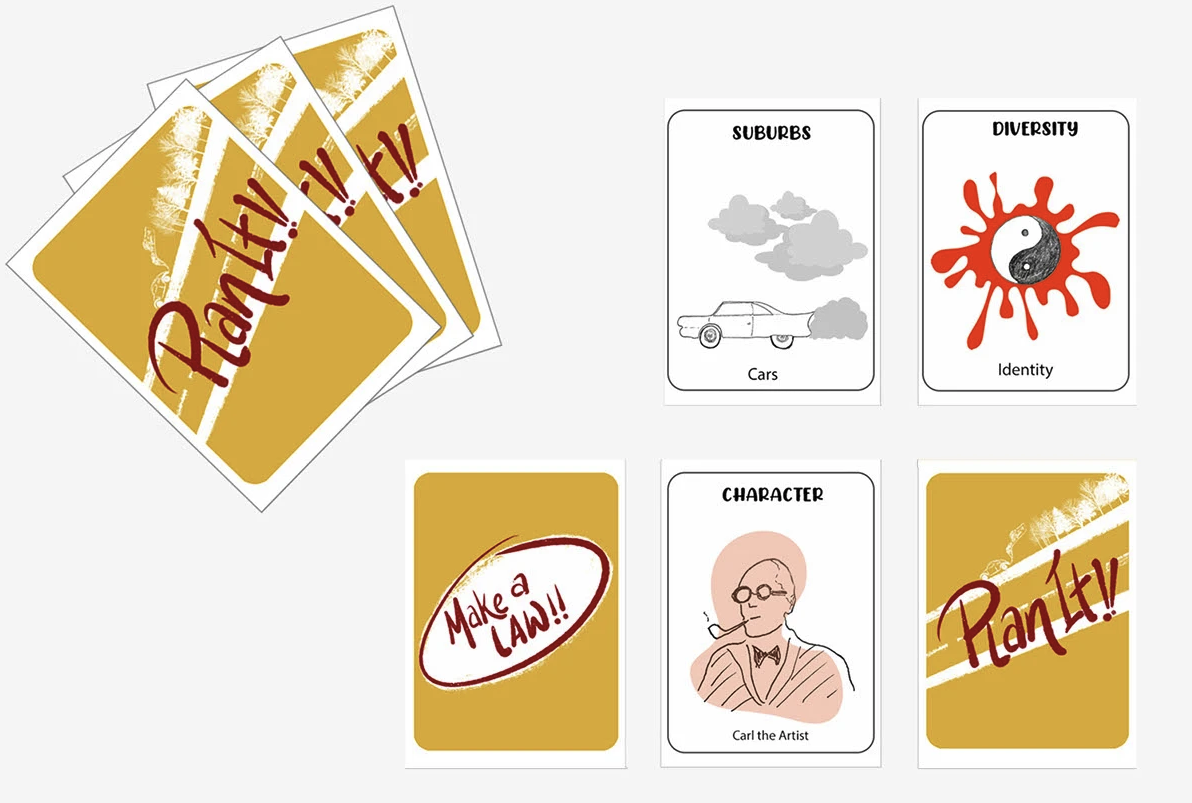
“Plan It!!” is a multi-player card game designed by three Urban Planners (Anonnya Islam, Salma Haoudi and Sam Gordon) to educate players on important themes, issues, and values in the contemporary world of urban planning. Similar to how a regular deck of cards is split into suits and numbers, the “Plan It!!” The deck of cards features 42 total cards and is split into thirteen (13) planning concepts made up of three (3) relevant sub-themes each. There are additionally three (03) law cards, which stimulate further creativity. This game can be played by a group of 3 – 6 players, ages six and above.
The goal of the Game:
Each player will collect as many “sets” of cards as possible. A set is defined as three (03) cards of the same category. Whoever has collected the most sets at the end of the game is the winner.
I. Theme Generation:
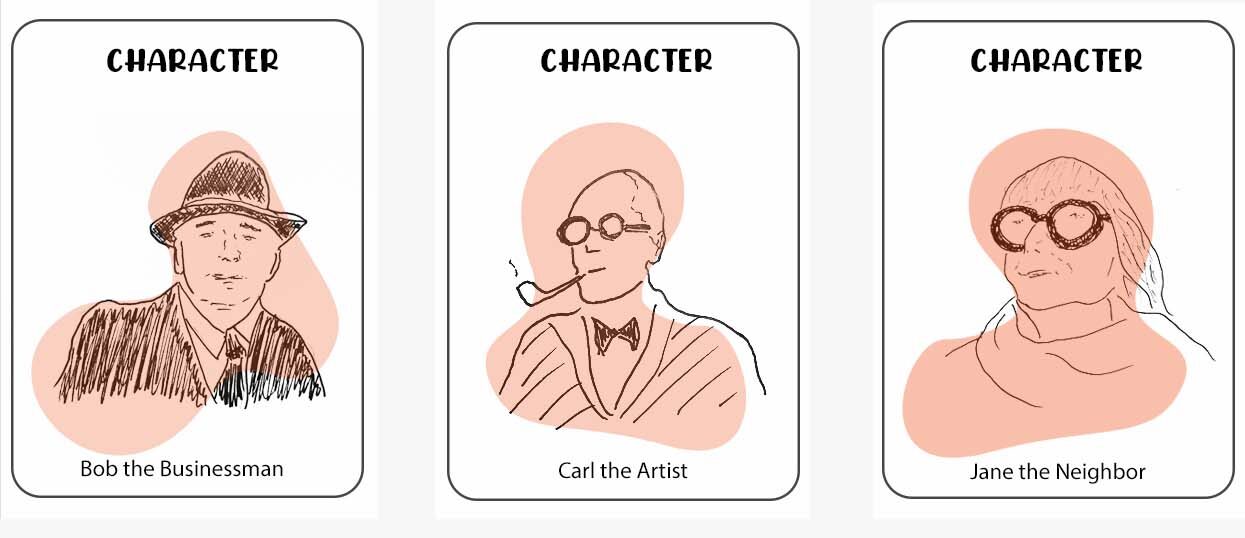
1. Characters: Bob the Businessman, Carl the Artist, Jane the Neighbor
The 20th century played host to numerous influential figures in the field of urban planning that have played important roles in how we view and experience our cities. Bob the Businessman is based on Robert Moses, a New York City’s high ranking public official who played a leading role in developing the city’s massive highway infrastructure in the 1950s and 1960s. Jane the Neighbor is based on the one and only Jane Jacobs, a resident of New York City during Robert Moses’ reign of influence who authored the book Death and Life of Great American Cities as an ode to protecting the human-scale livability of urban spaces. Carl the Artist is based on the modernist architect Le Corbusier, who was one of the many theorizers of new cities and urban spaces built on the foundations of efficiency and social order
2. City Life: Bus, Sidewalks, Townhouse Apartments
Ever since the end of the 20th century, the United States has witnessed a reinvigoration of urban spaces in lieu of suburbia’s rise after World War II. These three cards are meant to capture some of the major draws to the inner city spaces that newer age planning movements such as New Urbanism are attempting to emphasize: public transit, walkability, and higher density housing.
3. Conflict: Growth, Land, Resources
The three fundamental principles of the Planner’s Triangle – Equity, Environment, and Economic Growth – have three associated conflicts over: resources, property, and development.
4. Diversity: Identity, Income, Opinion
As we continue into the 21st century, our urban spaces are becoming more diverse than ever. This diversity is what makes them special places, and comes in many shapes and forms, whether it be race, gender identity, income, or opinion.
5. Garden Cities: Town, Country, Town-Country
The Garden City Movement was introduced in the rapidly urbanizing early 20th century as a potential living solution which would capture the “clean and green” benefits of both countryside living and the liveliness and economic opportunities of town/city living.
6. Goals: No Government, Dollars, Shopping
The era of Neoliberalism has served as an added and ever-growing layer of American capitalism since the 1970s, characterized by greater consumer spending, flow of capital, and less government regulation.
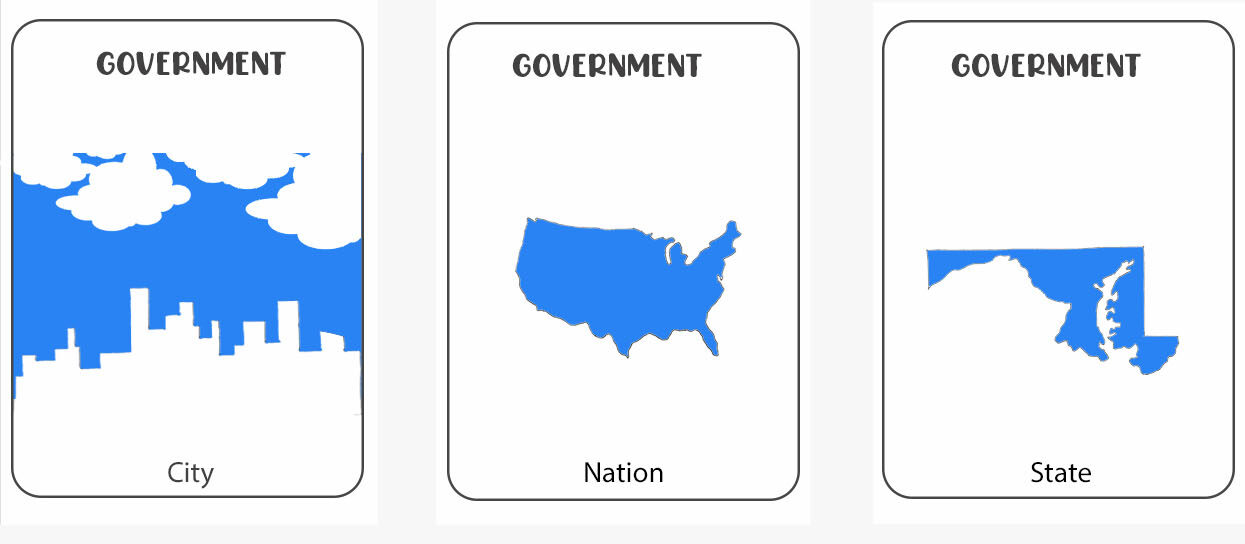
7. Government: National, State, City
The three layers of American government – national, state, and local (city) – serve as the political structure that the world of modern urban planning operates within.
8. Partnership: Government, Business, Community
This era of Neoliberalism has featured a rise in Public-Private Partnerships, where there has been an increasing reliance on collaborative efforts between the government and private sector in order to develop community projects.
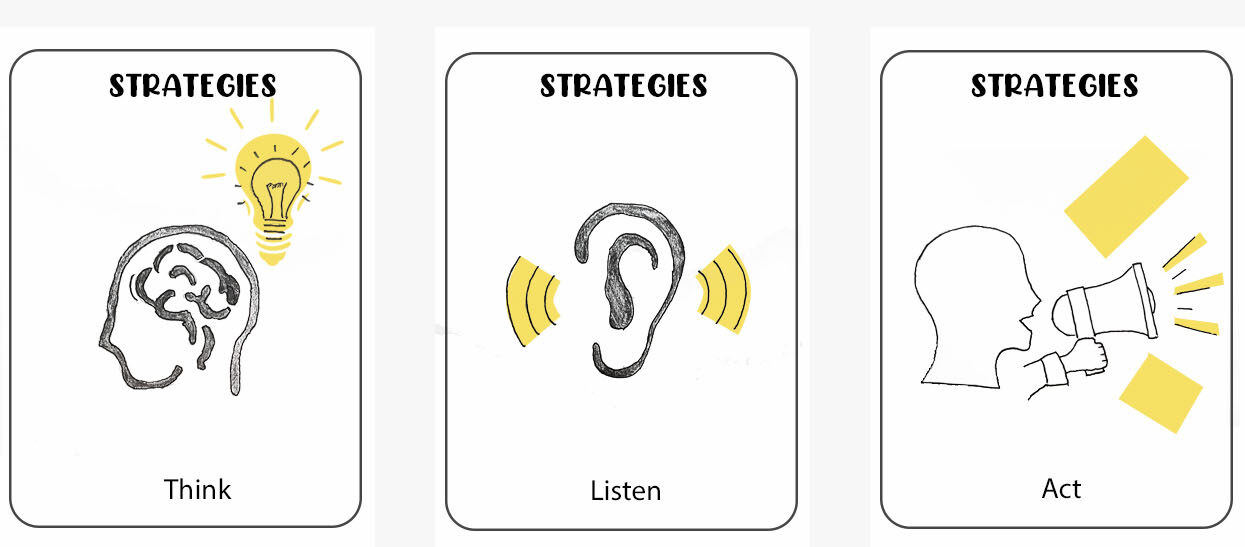
9.Strategies: Listen, Think, Act
As our urban spaces become increasingly diverse and multicultural, it is of added importance that urban planners continue to tactfully involve communities in the decision making process. This starts with listening, thinking, and acting/advocating.
10. Styles: Riles, Tools, Heroes
The “Three Historic Currents” of urban planners are considered to be the Technical practitioner, the Social Reformer, and the Social Justice practitioner.
11. Suburbs: Cars, Highways, Houses With Driveways
The rise of suburban neighborhoods in the post-World War II era are best represented by these three features: automobiles, highways, and single family homes.
12. Sustainability: Money, Equality, Nature
The three fundamental principles of the Planner’s Triangle – Equity, Environment, and Economic Growth – have three associated conflicts: over resources, property, and development.
13. Values: Competition, Market, You/Me
The framework of a capitalist economy built on values of competition, market, and individualism serves as the battleground on which urban planning ideals are played out.
II. Rules:
- Distribute five (5) cards facedown to each player (without anyone else being able to see what the cards are) and place the remaining cards facedown in the middle of the table.
- The player sitting on the left of the distributor starts the game by asking any one of their peers for a specific category of card that they might need to complete a set.
For example: Player 1 can ask Player 2, “Do you have any Sustainability cards?” Player 1 must actually have a “Sustainability” card already in order to ask another player for it. If Player 2 does have one or more of the requested Sustainability cards, they must give all of them to Player 1. If Player 1 successfully completes a set of three on this turn, they will then place all three of these cards on the table face up in front of everyone and get to take another turn.
If Player 2 does not have any Sustainability cards, then they tell Player 1 to “Plan it!!”, which means that Player 1 then gets to pick one random card from the facedown pile in the middle of the table.
Player 1’s turn is then over, and their peer to their left gets to go next.
- The game ends when all possible thirteen (13) sets of cards have been claimed. The winner is the player who has collected the most sets. During the game, if a player is left without any cards in their hand, they may (when it’s their turn to play), pick a new card from the middle pile and then ask for cards of that category. If there are no cards left in the middle pile, then they do not get to take a turn.
- Law cards shift the direction of the game. A player who has a law card in their hand can play it immediately, or save it for later. When a player decides to use a law card, they then enact a new rule (law) that mandates a “new” category featuring three cards from different categories that the other players then have to officially collect from that point forward.
Example: When Player 3 decides to use a law card, they may elect to define a new category that combines one card each from the “Sustainability”, “Government”, and “Values” sets. Player 3 will have to explain to their peers their reasoning and logic behind this rule. From this point forward in the game, all peers will have to follow this same rule/law. Unless…
If another player uses a law card later on in the game, they have the option of either a) deciding to get rid of Player 3’s original rule, OR b) creating a new rule of their own.